A research team led by Professor CHEN Wei from the Department of Physics and the Department of Chemistry at NUS developed a catalyst-regeneration strategy that could make hydrogen production from ammonia more efficient and reliable. By tackling a major problem that causes catalysts to lose their effectiveness over time, the team sustained hydrogen production for over 2,000 hours in laboratory tests.
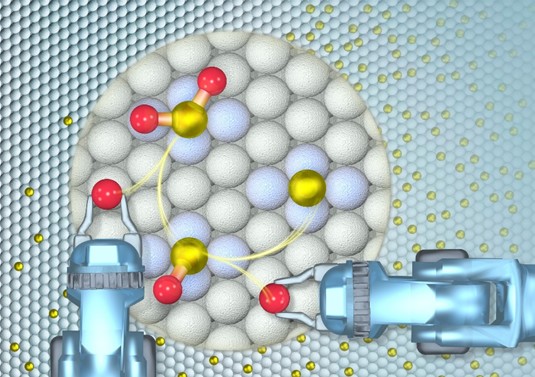
A catalyst comprising platinum nanoparticles supported on nitrogen-doped carbon containing atomically dispersed iron sites. Known as Pt/Fe-NC, the catalyst resists both platinum oxidation and nitrogen poisoning during ammonia oxidation.
First, electron transfer from the Fe-NC support suppresses platinum oxidation and accelerates the rate-determining dehydrogenation step. Second, Fe-N4 sites promote water dissociation, facilitating the hydrogenation of poisoning nitrogen species on platinum to form reactive NH-containing intermediates. This helps free up blocked sites and restore the catalyst’s activity.
The research work was carried out in collaboration with Assistant Professor OU Pengfei from the NUS Department of Chemistry and Professor FAN Lei from the University of Electronic Science and Technology of China. The research findings were reported in the scientific journal Nature Synthesis. Read the full article here.

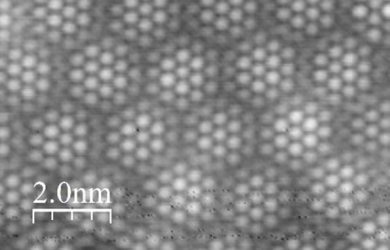
Figure: (a) Microscopy images showing platinum nanoparticles and individual iron atoms distributed across the catalyst’s carbon-based support. Scale bars: 100 nm (left), 50 nm (middle panels) and 2 nm (right). (b) Comparison of ammonia oxidation activity between the new catalyst (Pt/Fe-NC) and a commercial platinum catalyst (Pt/C). (c) The catalyst’s design helps prevent platinum oxidation and regenerate sites blocked by nitrogen. (d) Periodic switching of electrical conditions helps restore catalyst activity, while (e) acid washing removes accumulated nitrogen to enable further regeneration. (f–g) The combined regeneration strategy, involving periodic electrical switching, acid washing and ammonia replenishment, sustained hydrogen production for over 2,000 hours at a lower current density and 500 hours at a higher current density, respectively. [Credit: Nature Synthesis]