
The Singapore National Crystal Growing Challenge

The 17th Singapore National Crystal Growing Challenge will be held on 30 May 2026 (Saturday) at the National University of Singapore. We invite students from secondary schools, international schools, junior colleges, ITE colleges, and polytechnics in Singapore to participate in this enriching scientific competition. The challenge offers students an opportunity to explore the principles and practice of crystal growth, deepening their understanding of fundamental chemical processes. Through this hands-on experience, participants will develop scientific curiosity, experimental skills, and an appreciation for the elegant chemistry underlying crystal formation. We look forward to welcoming the next generation of young scientists to engage, learn, and excel in this event.

  • There will be 2 categories in this competition. They are:
    • Junior category–for secondary school students
    • Open category–for secondary, junior college, ITE college and polytechnic students
  • Each institution may submit a maximum of 2 entries for each level.
  • No more than two students should be involved with each entry.
  • One student is only allowed to participate in one entry.
  • All crystals must be grown at their respective institutions, under the supervision of a teacher.
  • Based on common scientific practices, students should record all their experiments in a log book.
  • Students and teachers are required to follow the appropriate safety procedures.
  • Only 1 selected crystal will be submitted to represent their institution in this challenge at each level.
  • The prize-winning crystals will be retained by the Department of Chemistry, NUS and may be used for display and advertisement purposes. By entering this competition, participants agree to abide by this policy.

Single Crystal of Copper(II) Sulfate Pentahydrate Copper(II) sulphate pentahydrate is one of well-known hydrate forms of this salt. The crystal structure contains pseudo-octahedral or tetragonal Cu2+ ions surrounding by six oxygen atoms of water molecules and sulphate ions, forming an infinite chain of Cu2+ and SO42- ions. This transition metal salt can be produced industrially by dissolving copper metal with hot concentrated sulfuric acid or copper oxides with dilute sulfuric acid. Bright-blue crystals of copper(II) sulphate pentahydrate can be grown from the aqueous solution of copper(II) sulphate. Owing to its redox properties of Cu(II) oxidation state, it acts as an analytical reagent to detect reducing sugars and proteins. Besides its use in electroplating industry, it is also a fungicide, herbicide, and molluscicide.

Evaluation Rubrics for Junior Category

  • Presentation of Materials (max. 30 points)
    • Poster (max. 20 points)
    • The poster should have the following components clearly labelled / displayed: (i) Title, (ii) Names of the Student(s), Teacher(s) and School; (iii) Purpose Statement; (iv) Experimental Description & Results; (v) Relevant Scientific Contents of Crystal; (vi) Conclusion and Comments/Suggestions. The teams may discuss the problems encountered and how they were tackled. Other than the aesthetic appeal, the judges will be looking for understanding of crystallization and discussion on how the students uncover ways to grow bigger and better quality crystals. Did the students experimented with different crystallization conditions e.g. temperature, concentration, rate of cooling, types of solvent? At least 3 photographs at various stages of crystal growth should be provided. References should be cited where applicable. 
    • Logbook (max. 10 points)
    • Show it together with your crystal display on-site. Is it dated and properly logged? Are all the experimental data, procedures and materials used, and observations well-documented? Are all the problems encountered carefully recorded? How about its overall design and clarity, etc.

  • Crystal Quality (max. 70 points)
    • Singularity– Is it a single crystal? Any twining or intergrowth problem? (max. 30 points)
    • Appearance – Any well-defined crystal faces, sharp and consistent angles & straight edges? Crystals should be grown naturally, cut, polished, glued or joined together by any other means. (max. 10 points)
    • Clarity– Is it transparent & clear? Crystals should not be dyed. Any scratches or faults on the surfaces? Are there any occluded bubbles or “hair” streaks inside the crystals?  (max. 10 points)
    • Crystal Size & Weight – Give the mass in gram & dimension: L´W´H in mm. Note that the crystal size alone is not the primary judging criteria, as compared to its singularity, which has a higher score weightage. (max. 20 points)

This is just a guidance and the judges are free to select any beautiful looking and very attractive big SINGLE crystals unanimously amongst all entries.

Submission checklist:
  1. Poster (Portrait, coloured and A1-sized. It will be vertically mounted on the provided supports at the venue)
  2. Crystal display (one piece per entry only, any protective cover or encasement must be clear and colourless, without interfering the original appearance of crystal, decoration is not necessary).  No decoration is required and if any, the decoration will not be part of the grading. 
  3. Log book (showing well-organized data track records and observations for judges’ reference)

The prizes for the winning teams:

  1. The Champion: trophy, certificate, and voucher of S$200
  2. 1st Runner-up: trophy, certificate, and voucher of S$160
  3. 2nd Runner-up: trophy, certificate, and voucher of S$ 120
  4. Largest Single Crystal: certificate and voucher of S$100
  5. Best Poster: certificate and voucher of S$80
  6. Meritorious award 1: certificate and voucher of S$60
  7. Meritorious award 2: certificate and voucher of S$60

The registration:

  • Click here to register.
  • Registration fee: $60 + GST per team (not refundable)
  • Registration deadline: 8 March 2026 or whenever the full registration is reached.
  • For enquiries, please email to: chemistry-outreach@nus.edu.sg

The Longest Single Crystal For this category, contestants are tasked to prepare a colourless, or coloured single crystal with one longest dimension. The crystal should be transparent without twining or intergrowth problem, and visible defects. Such kind of crystal should also clearly display well-defined crystal faces. If two shortlisted single crystals have the same length, the next criteria would be the actual crystal weight or size. The choices of compound for crystallisation and method of crystallisation are left to the contestants but the compound for the junior level this year must not be used. It can be an inorganic, or organic compound but the chemical name of the crystal must be stated clearly for assessment. The main objective of this category is to provide contestants with an opportunity to exercise their creativity, curiosity, individuality and scientific knowledge.

Evaluation Rubrics for Open Category

  • Presentation of Materials (max. 30 points)
    • Poster (max. 20 points)
    • The poster should have the following components clearly labelled / displayed: (i) Title, (ii) Names of the Student(s), Teacher(s) and School; (iii) Purpose Statement; (iv) Experimental Description & Results; (v) Relevant Scientific Contents of Crystal; (vi) Conclusion and Comments/Suggestions. The poster should also explain the choice of compound and chemical materials used, and state clearly if they are commercially obtained or prepared. For the latter, chemical equations and some details of synthesis may be provided. Other than the aesthetic appeal, the judges will be looking for novelty, level of difficulty, time and effort spent on this event, together with students’ understanding on crystal growth, the problems encountered and how they were tackled. Did the students experimented with different crystallization conditions e.g. temperature, concentration, rate of cooling, types of solvent? At least 3 photographs at various stages of crystal growth should be provided. References should be cited where applicable.
    • Logbook (max. 10 points)
    • Show it together with your crystal display on-site, is it dated and properly logged? Are all the experimental procedures and materials used documented? Are all the problems encountered carefully recorded? How about its overall design and clarity, etc.

  • Crystal Quality (max. 70 points)
    • Singularity– Is it a single crystal? Any twining or intergrowth problem? (max. 30 points)
    • The Longest Dimension – How long of the crystal is found for this category? (max. 10 points)
    • Clarity– Is it transparent & clear? Crystals should not be dyed. Any scratches or faults on the surfaces? Are there any occluded bubbles or “hair” streaks inside the crystals?  (max. 10 points)
    • Crystal Size & Weight – Give the mass in gram & dimension: L´W´H in mm. Note that the crystal size alone is not the primary judging criteria, as compared to its singularity, which has a higher score weightage. (max. 20 points)

This is just a guidance and the judges are free to select any beautiful looking and very attractive big SINGLE crystals unanimously amongst all entries.

Submission checklist:
  1. Poster (Portrait, coloured and A1-sized. It will be vertically mounted on the provided supports at the venue)
  2. Crystal display (one piece per entry only, any protective cover or encasement must be clear and colourless, without interfering the original appearance of crystal, decoration is not necessary).  No decoration is required and if any, the decoration will not be part of the grading. 
  3. Log book (showing well-organized data track records and observations for judges’ reference)

The prizes for the winning teams:

  1. The Champion: trophy, certificate, and voucher of S$200
  2. 1st Runner-up: trophy, certificate, and voucher of S$160
  3. 2nd Runner-up: trophy, certificate, and voucher of S$ 120
  4. Largest Single Crystal: certificate and voucher of S$100
  5. Best Poster: certificate and voucher of S$80
  6. Meritorious award 1: certificate and voucher of S$60
  7. Meritorious award 2: certificate and voucher of S$60

The registration:

  • Click here to register.
  • Registration fee: $60 + GST per team (not refundable)
  • Registration deadline: 8 March 2026 or whenever the full registration is reached.
  • For enquiries, please email to: chemistry-outreach@nus.edu.sg

The 17th Singapore National Crystal Growing Challenge

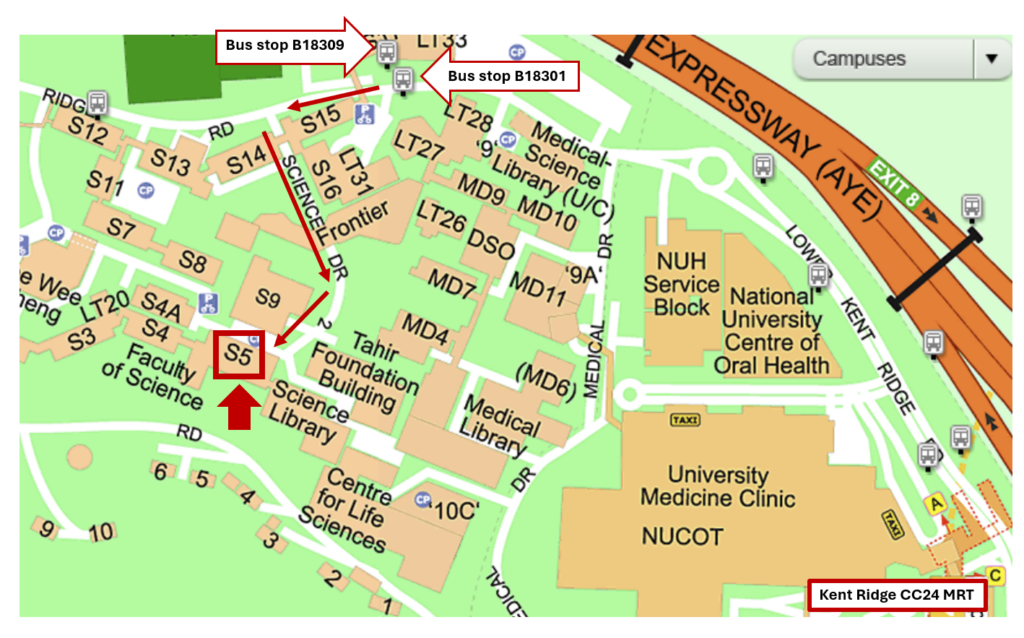
Date: 30 May 2026 (Sat) Time: 08:45 – 14:00 Venue: General Synthetic Chemistry Teaching Laboratory, NUS Chemistry, Block S5 Level 1, Science Drive 2, Singapore 117546 [map]
To be updated in April 2026